How to Sync Attio and Google Sheets Two-Way (5 Methods)
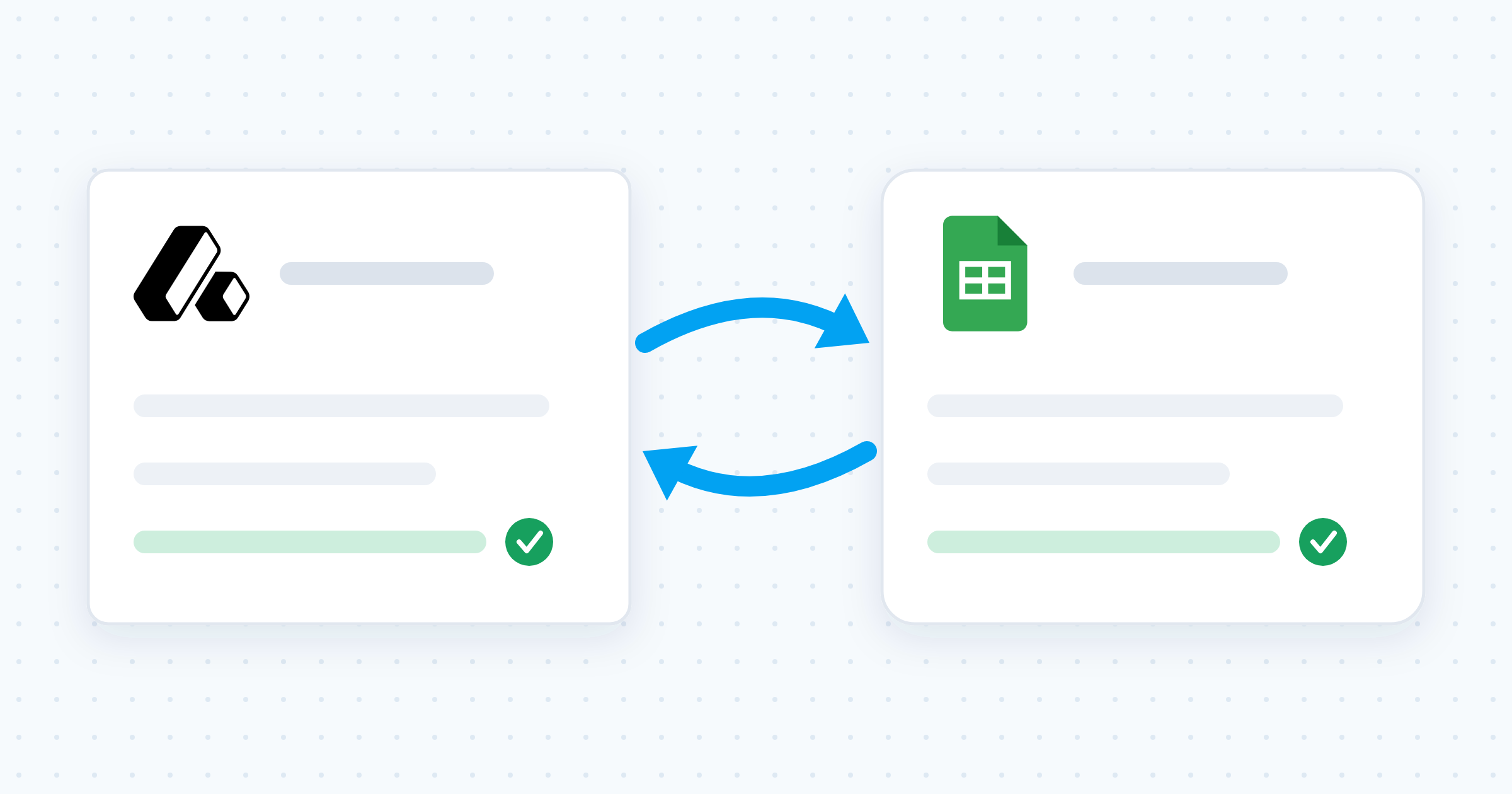
Five ways to connect Attio and Google Sheets, compared: CSV export, connector apps, Zapier, the Attio API, and real-time two-way sync.

How to Sync Attio and Google Sheets (Two-Way)
Your CRM lives in Attio. Your reporting lives in Google Sheets. Between them sits a weekly ritual: export a CSV, paste it into a sheet, fix the broken columns, rebuild the pivot tables.
Quick answer: five methods connect Attio and Google Sheets. A CSV export gives a one-off snapshot. Connector apps, including the Google Sheets app in Attio’s marketplace, move records on a schedule. Zapier and Make push one event at a time, one direction per workflow. The Attio API needs a developer. For a live two-way link, where an edit in either tool reaches the other, use a sync tool such as Whalesync: pick the two apps, map your fields, turn the sync on. No code, minutes to set up.
Every way to connect Attio and Google Sheets
Read the trade-offs first, then pick.
| Method | Direction | Setup effort | Stays current | Best for |
|---|---|---|---|---|
| CSV export and import | Attio to Sheets, once | Minutes, every time | No | A snapshot before one meeting |
| Connector apps (marketplace app, Outfunnel) | One or both, on a schedule | Low, no code | On the app’s schedule | Routine record exports |
| Zapier or Make | One direction per workflow | Medium, per event type | Only events you built | Logging new records as rows |
| Attio API or Apps Script | Whatever you build | High, needs a developer | Only if you maintain it | Custom logic engineering owns |
| Whalesync two-way sync | Two-way | Minutes, no code | Yes, in real time | Live reporting and bulk edits |
1. CSV export and import
Export the object or list from Attio as a CSV, then open Google Sheets and use File > Import. Fine for a snapshot. As a system it fails three ways:
- The data is stale on arrival. Every report built on a CSV shows last week’s pipeline.
- It is manual. Someone must remember to export, clean, and paste, every single time.
- Edits go nowhere. Fix a deal amount in the sheet and Attio never hears about it.
2. Connector apps (Attio’s marketplace app, Outfunnel)
Attio lists a Google Sheets app in its marketplace, built by a third-party developer (appstronauts) rather than by Attio. Setup runs in three steps: connect both accounts, choose the Attio object (People, Companies, and other supported objects) and the sync direction, then pick the sheet and map fields to columns. Listed directions are Sheets to Attio, Attio to Sheets, or bidirectional.
Outfunnel is a similar option. Its integration page advertises syncing new Attio records to Sheets or the reverse, matching fields to columns, and filtering by segment, from $29 per month with a 14-day free trial.
Check this before you commit. Neither listing publishes a sync frequency, a record volume limit, or the field types it supports, and marketplace app support runs through the developer’s own site.
3. Automation tools (Zapier, Make)
Zapier connects Attio triggers (record created, updated, or deleted, plus list entries and tasks) to Google Sheets actions like create row and update row. That covers logging. The limits appear fast:
- One direction per workflow. Two Zaps pointed at each other can echo each other’s updates, so most teams run one direction and stop.
- Triggers, not tables. Each event type needs its own workflow, so updates and deletions slip through and rows drift out of date.
- Per-task pricing. An active pipeline burns through monthly task limits quickly.
4. The Attio API or a Google Apps Script
Attio offers a modern API, and a developer can call it from a Google Apps Script at no license cost. You then own authentication, pagination, rate limits, error handling, and every schema change. Fair trade when engineering owns the pipeline, bad trade when the spreadsheet belongs to ops.
5. Two-way sync with Whalesync
Whalesync treats Attio and Google Sheets as two views of the same table. Create a record in either tool and it appears in the other. Edit a cell in Sheets and the change lands back in Attio. Companies, people, deals, and custom objects are supported, with no triggers to maintain and no code to write.
One-way sync in two directions is not two-way sync
Plenty of tools list bidirectional as a checkbox and deliver it as two scheduled one-way jobs. The difference shows up on the messy days: two people edit the same record, or someone deletes a row. A true two-way sync holds one record identity across both tools and reconciles the change. Two stacked one-way jobs can overwrite the newer value with the older one.
So ask any vendor three questions: how fast does a change travel in each direction, what happens when both sides edit the same field, and what happens to a deleted row. Stacksync, another two-way option, answers publicly, advertising sub-second propagation from Attio to Sheets, interval-based propagation back, and field-level conflict resolution, though it publishes no pricing. Whalesync syncs in real time in both directions, with visual field mapping and no code.
The payoff: the spreadsheet stops being a dead end. Clean up a hundred records with familiar moves (filter, sort, drag to fill) and the fixes reach Attio.
How to sync Attio and Google Sheets with Whalesync
Five steps, minutes end to end.
Step 1: Create a new sync. Sign in to Whalesync and create a sync, choosing Attio and Google Sheets as the pair. A sync is the connection that keeps two tools mirrored.
Step 2: Authorize both apps. Connect your Attio workspace and your Google account. Whalesync walks you through each authorization.
Step 3: Map your tables and fields. Choose which Attio data (companies, people, deals, or a custom object) pairs with which sheet, then match fields to columns. The visual mapper shows both sides, so you decide exactly what syncs.
Step 4: Activate the sync. From this point, Whalesync keeps both tools aligned automatically.
Step 5: Watch your records sync. Rows fill in as Attio records land in your sheet. From here, edit in whichever tool fits the task.

Set your sheet up before you turn the sync on
Five minutes here saves a rebuild later, whichever method you picked.
- One tab per Attio object. Companies, people, and deals each get their own tab.
- Row 1 holds headers only. No logo, no title row, no merged cells above it. Connectors read the first row as field names.
- Keep formulas off the synced tab. Build charts and pivots on a separate reporting tab that references the synced one, because rows move as records arrive.
- Map a narrow field set first. Start with the ten fields your report needs, confirm they land, then add more.
- Decide the source of truth per field. Owner and stage usually belong to Attio. A forecast multiplier belongs to the sheet.
What to build once Attio and Google Sheets stay in sync
Live reporting and board decks. Point your charts, pivot tables, and formulas at a sheet that mirrors Attio in real time. The synced sheet behaves like a live database, so our guide to using Google Sheets as a database applies directly.
Forecasting with finance and advisors. Many stakeholders live in spreadsheets, not CRMs. Share the synced sheet and they slice pipeline data their own way while your team works in Attio.
Bulk edits and data cleanup. Renaming accounts or reassigning owners across hundreds of records is painful in any CRM. Do it in Sheets with sort, filter, and find-and-replace.
Frequently asked questions
Does Attio have a native Google Sheets integration?
Not one built by Attio. Its app marketplace lists a Google Sheets app, but a third party builds it (appstronauts) and support runs through their site. It offers Sheets to Attio, Attio to Sheets, or bidirectional sync, though the listing documents no sync frequency or volume limits.
Is there a free way to connect Attio and Google Sheets?
Two, with caveats. A CSV export costs nothing, but it is a snapshot, not a sync. A Google Apps Script that calls the Attio API carries no license cost, though someone has to maintain it through every schema change. Free automation tiers cap monthly tasks, so check the cap against your record volume first.
Which Attio objects can I sync to Google Sheets?
With Whalesync: companies, people, deals, and custom objects, each mapped to its own sheet tab. Custom objects matter more in Attio than in most CRMs, because the data model is meant to be reshaped. Confirm custom object support before committing to any method, since some listings name only People and Companies.
Can the sync run one way instead of two ways?
Yes, depending on the method. Zapier and Make are one direction per workflow, and the marketplace app lets you choose Attio to Sheets, Sheets to Attio, or both. Pick one way when the sheet is read-only reporting. Pick two-way when you want the cleanups and forecasts you make in Sheets to count in the CRM.
Does Zapier support two-way sync between Attio and Google Sheets?
Not as a single feature. Zapier gives you triggers and actions on both sides, so you can build a Zap in each direction, but they run as two independent workflows. An update one Zap makes can fire the other, and neither knows the two records are the same record. That gap is what a dedicated two-way sync tool closes.
Next steps
Still deciding whether Attio is your CRM? Our Attio vs Folk comparison breaks down how the two stack up for GTM teams.
Ready to retire the CSV ritual? Create your first sync with Whalesync, or see the pair on the Attio and Google Sheets connect page. Setup takes minutes, and the spreadsheet never goes stale again.
Subscribe for more
Stay up to date with the latest no-code data news, strategies, and insights sent straight to your inbox!