How to Sync Notion and Supabase (Two-Way, No Code)
Every way to sync Notion and Supabase, compared honestly: Supabase Wrappers, workflow automations, CSV, and custom scripts, plus a five-step no-code two-way setup.

How to Sync Notion and Supabase (Two-Way, No Code)
Your production data lives in Supabase. Your team lives in Notion. So every week someone exports a table, pastes it into a Notion database, and edits a copy that goes stale the moment your app writes a new row.
Quick answer: six methods connect Notion and Supabase, and only one keeps both sides current. Supabase’s own Notion wrapper reads Notion into Postgres but cannot write back. Workflow tools such as n8n, Make, and Latenode fire in one direction per workflow. CSV is a snapshot, and custom scripts become software you maintain. A dedicated sync tool like Whalesync connects the pair with real-time, two-way sync and no code, so an edit in either app lands in the other. Compare all six below, then follow the five-step setup.
Every way to sync Notion and Supabase, compared
| Method | Direction | Effort | Best for |
|---|---|---|---|
| Whalesync | Two-way, real time | No code, minutes | Running Notion as a live front-end for Supabase |
| Supabase Wrappers (Notion FDW) | One-way, Notion to Postgres, read only | SQL setup | Querying Notion data from inside Postgres |
| Workflow automations (n8n, Make, Latenode, Zapier) | One direction per workflow | One build per event type | Event handoffs and data transforms |
| CSV export and import | One-time snapshot | Minutes, repeated by hand | A single migration |
| Custom API scripts | Whatever you build | High, and ongoing | Bespoke logic an engineer owns |
| Supabase dashboard alone | No sync | None | Developers editing rows directly |
Each option works. Each has a real limit.
Supabase Wrappers: read Notion from Postgres
Supabase ships a Notion foreign data wrapper that exposes Notion pages, databases, blocks, and users as foreign tables you can query with SQL. It is native and included with your project. Two limits decide whether it fits. First, it is read only: Supabase’s own docs mark insert, update, and delete as unsupported on those tables, so nothing you change in Postgres reaches Notion. Second, it is slow on large result sets, because the wrapper pulls full data and pushes down filters only on ID columns. Setup is SQL: enable the wrappers extension, store your Notion key, create the foreign server, import the table definitions. Good for analysts querying Notion. Not a way to give your team an editable Notion view of app data.
Workflow automations: one direction per build
n8n, Make, Latenode, and Zapier-style tools connect the pair with triggers and actions: when a Notion page is created, insert a Supabase row. That covers one event, in one direction. Updates and deletions each need their own workflow, bulk changes burn run quotas, and pointing two one-way workflows at each other risks an update loop where each side keeps re-triggering the other. The reverse direction is often thinner than the forward one. TinyCommand’s integration page, for example, lists Notion triggers but no Supabase triggers, so Supabase to Notion relies on a scheduled check rather than an instant one. These tools automate handoffs well. They do not keep two databases identical.
CSV export and import
Export a CSV from Supabase, import it into a Notion database, and you have a browsable copy in about two minutes. You also have a snapshot that ages immediately. Notion edits never travel back, and repeating the import next week creates duplicates instead of updates. CSV suits a one-time migration, not an ongoing workflow.
Custom scripts against the APIs
Both apps offer solid APIs, so an engineer can script the connection. The hidden cost arrives after version one: rate limits, retries, schema changes, and conflict resolution when both sides edit the same record. The script becomes internal software someone maintains forever.
Skip the sync and use the Supabase dashboard
Supabase ships a built-in table editor that costs nothing extra. The limit: it is a database console built for developers. No comments, no linked docs, no friendly views, and every edit hits production live. Handing the whole team console access is a risk most founders would rather avoid.
Why two-way sync beats one-way
A one-way pipeline turns Notion into a read-only mirror. That works for a dashboard, but it defeats the point of using Notion as your front-end: the moment a teammate fixes a typo, updates a status, or annotates a record, that change is stranded in Notion.
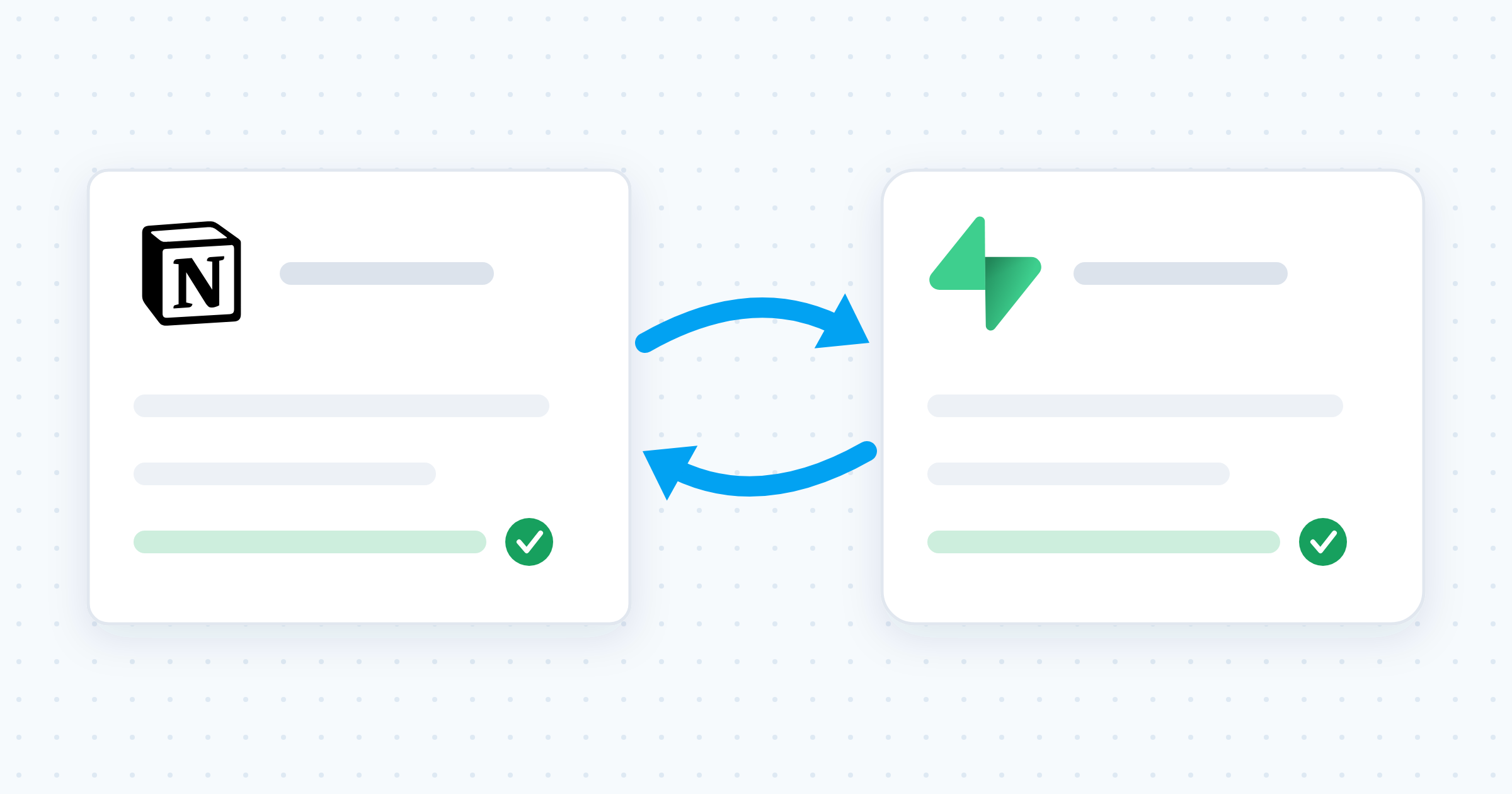
Two-way sync gives you one source of truth with two interfaces. Edit a record in Notion and the row updates in Supabase, where your app reads it. When your app inserts a row, the record appears in Notion, ready to browse and annotate. Nobody reconciles anything, because there is nothing to reconcile.
How to two-way sync Notion and Supabase with Whalesync
Whalesync connects the pair with real-time, two-way sync and no code. Setup takes minutes.
Have three things ready first:
- A Supabase table with a primary key, so every row has a stable identity to match on
- A Notion database in a workspace you can authorize
- A decision about which app owns each field, covered below
Step 1: Create a new sync. Sign up for Whalesync, create a sync, and choose Notion and Supabase as your two apps.
Step 2: Authorize both apps. Securely connect your Notion workspace and your Supabase project. Whalesync walks you through each authorization in seconds.
Step 3: Map your tables and fields. Pick which Supabase table pairs with which Notion database, then visually match the fields you want to keep in sync. The usual pairings: a text column to rich text, a timestamp to a date property, a boolean to a checkbox, an enum or status column to a Notion select.
Step 4: Activate your sync. Flip the sync on. Whalesync runs automatically in the background from here.
Step 5: Watch your records sync. Your Supabase rows appear as Notion pages. Change one in Notion and watch the edit land back in Supabase in real time.

Three things to get right before you sync
Give every row a stable ID. A sync matches records by identity, not by position. If your Supabase table has a primary key and you never recycle it, records stay paired. Rebuilding a table from scratch breaks those pairs.
Decide who owns each field. Pick, per field, whether Notion or your app is the authority. Computed columns and app-generated values belong to Supabase. Statuses, notes, and review flags belong to the team in Notion. That decision costs five minutes and prevents most confusion later.
Start with one table. Sync a single low-risk table first, watch a few edits move both ways, then add the rest. It is faster than debugging six tables at once.
What teams build with a Notion and Supabase sync
A friendly admin panel. Support and ops teammates browse customer records in Notion, fix bad data, and add context in the tool they already use daily, while the app keeps reading from Supabase. If Supabase itself still feels foreign, start with our no-coder’s guide to Supabase.
A content and catalog workspace. Product listings, help articles, or directory entries live in Postgres for the app to serve, but the team drafts, reviews, and edits them as Notion pages. The same pattern powers multi-workspace setups; see how teams link Notion databases with two-way sync.
An operations layer on production data. Statuses, review flags, and internal notes edited in Notion flow straight back into Supabase, so workflows built on the database always see the team’s latest decisions. For a broader look at how these two tools fit together, read our overview of Supabase and Notion sync.
Frequently asked questions
Can Notion and Supabase sync in both directions?
Yes, with a dedicated sync tool. Whalesync keeps the pair in real-time, two-way sync, so an edit in Notion updates the Supabase row and a new row in Supabase appears as a Notion page. Most other routes are one-way by design: Supabase’s Notion wrapper only reads, and each automation workflow runs in a single direction.
Does Supabase have a native Notion integration?
Yes, but it reads only. Supabase Wrappers includes a Notion foreign data wrapper that exposes Notion pages, databases, blocks, and users as foreign tables you can query in SQL. Supabase documents insert, update, and delete as unsupported on those tables. Use it to analyze Notion data in Postgres, not to let your team edit app data from Notion.
Is a Notion and Supabase sync real-time?
It depends on the method. Whalesync syncs in real time in both directions. Workflow automations vary: some fire on a webhook within seconds, others check for changes on a schedule, so the lag depends on the trigger you pick and the plan you are on. CSV imports are never live.
Do I need to write code to connect Notion and Supabase?
No. Whalesync setup is no-code: authorize both apps, map the fields visually, turn the sync on. Coding only becomes necessary if you build the connection yourself against the two APIs, or if you use Supabase Wrappers, which is configured in SQL.
What happens if someone edits the same record in both tools?
Avoid the situation rather than solve it. Decide up front which app owns each field: app-generated values stay owned by Supabase, and human judgment fields like status or notes stay owned by Notion. If you build the connection with two one-way automations pointing at each other, watch for update loops, where each write re-triggers the other side.
Ready to stop copy-pasting? Get started with Whalesync and set up your first sync in minutes, or explore the pair on the Notion and Supabase connect page.
Subscribe for more
Stay up to date with the latest no-code data news, strategies, and insights sent straight to your inbox!