How to Two-Way Sync Airtable and Notion (5 Methods Compared)
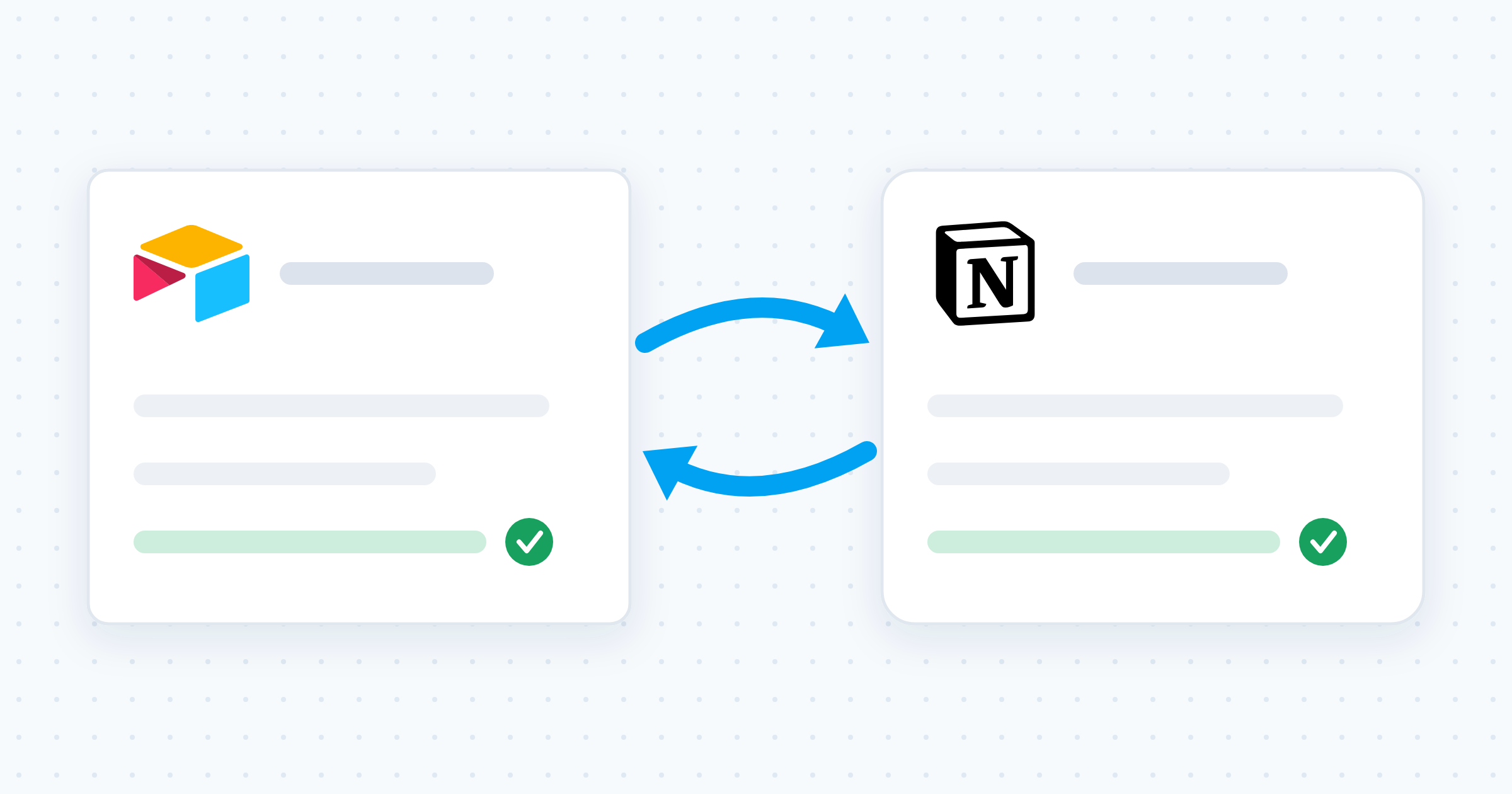
Five ways to connect Airtable and Notion, compared honestly, plus a five-step setup for a real-time, two-way sync.

How to Two-Way Sync Airtable and Notion (5 Methods Compared)
Your team writes in Notion and tracks in Airtable. Docs and project context live in Notion. Structured data (CRM, content calendar, trackers) lives in Airtable. Each tool is right for its job, and the two still drift apart.
Quick answer
Neither app has a built-in two-way sync with the other, so you need a third-party tool. Airtable’s native two-way sync connects Airtable bases to other Airtable bases only. Notion’s synced databases pull from Jira, GitHub, Asana, and GitLab, in one direction only. To keep the same records live in both tools, use a two-way sync tool such as Whalesync: map your Airtable table to your Notion database once, hit activate, and every edit mirrors both ways in real time. Setup is no-code and takes minutes. All five methods and the full walkthrough are below.
Five ways to connect Airtable and Notion
Start with the table. Each method below gets its steps and its honest limits.
| Method | Direction | Effort | Best for |
|---|---|---|---|
| CSV export and import | One-time copy, no sync | 10 minutes | A single migration |
| Airtable embed in Notion | Read-only view | 2 minutes | Showing a base inside a doc |
| Native sync in either app | Not available for this pair | None | Nothing, yet |
| Zapier or Make automation | One direction per automation | 30 minutes and up | Copying new records |
| Two-way sync tool | Both directions, real time | About 5 minutes | One dataset, two tools |
1. CSV export and import (one time only)
Best for moving a base into Notion once.
- In Airtable, open the view you want and download it as a CSV.
- In Notion, click Import in the sidebar and choose CSV.
- Open the new Notion database and fix the property types. Text and select are the usual defaults.
The limits. The snapshot goes stale the moment you export it, and a re-import creates duplicates because the CSV carries no record of what changed. Linked records do not survive the trip: relations arrive as plain text. Notion also caps import file size (5 MB per file on the free plan), so a large base has to be split.
2. Embed an Airtable view inside a Notion page
Best for showing a base to readers without moving any data.
- In Airtable, create a shared view link.
- In Notion, type /embed, paste the link, and resize the block.
The limits. An embed is a window, not data. It is read-only by default, and the records never become Notion pages. You cannot relate them to a Notion database, filter them in Notion views, or find them in Notion search.
3. Native sync, and why it does not cover this pair
Both apps ship a sync feature. Neither one connects Airtable to Notion.
- Airtable two-way sync links a source table to target tables in other Airtable bases. Airtable lists it on Business and Enterprise Scale plans.
- Notion synced databases pull from Jira, GitHub, Asana, and GitLab. Notion states the sync runs in one direction only, on Business and Enterprise plans.
If a guide tells you to paste an Airtable link into a Notion sync block, check its date against Notion’s own help page. Airtable is not on the supported list.
4. One-way automation (Zapier, Make, n8n)
Best for copying new records in a single direction.
- Pick a trigger, for example New Record in Airtable.
- Pick an action, for example Create Data Source Item in Notion.
- Map each field by hand, then switch the automation on.
The limits. Edits do not flow back. Keeping existing records current means a second automation for updates and a third for the reverse direction. Two one-way automations pointed at each other can trigger each other in a loop unless you add guard conditions. Pricing is task-based, so cost grows with every record that moves.
5. Two-way sync tools
Best for treating one Airtable table and one Notion database as a single dataset. Whalesync syncs the pair in real time in both directions, with visual field mapping and no code. Unito and Getint also sync this pair both ways. Unito documents two Airtable prerequisites, a single-line text field named Title and a Last Modified Time field, plus a limit of one connected Notion user per workspace.
Why two-way sync beats one-way automation
- Edits flow both directions. Update a status in Notion and Airtable follows. Nobody has to remember which tool holds the real record.
- Existing records sync too. Whalesync syncs your historical data when you activate, not only changes going forward.
- Map once, not per change. You map tables and fields one time instead of building an automation for every kind of update.
How to two-way sync Airtable and Notion with Whalesync
Before you start: you need a Whalesync account and edit access to both the Airtable base and the Notion pages you plan to sync. Budget five minutes.
Step 1: Create a new sync
Sign in to Whalesync and create a new sync. Choose Airtable and Notion as the two apps to connect.
Step 2: Authorize both apps
Connect your Airtable account, then your Notion workspace. Grant access to the base and the pages you want to sync. Whalesync handles the API details, including rate limits and retries.
Step 3: Map your tables and fields
Pair each Airtable table with its matching Notion database, then map the fields: Name to Name, Status to Status, and so on. Match the field types on both sides. Whalesync supports rich text, images, and multi-reference fields, so linked records carry over intact. Add a filter here if you only want part of the table to sync.
Step 4: Activate the sync
Click activate. Whalesync runs the first sync and brings your existing records into line on both sides. This first pass covers the whole table, so it takes longer than the updates that follow.
Step 5: Confirm both directions
Edit a record in Airtable and watch it appear in Notion. Edit the same record in Notion and watch Airtable follow. Test one field of each type you mapped, especially rich text and linked records. From here it runs in the background, in real time, both ways, with no maintenance.

What teams sync between Airtable and Notion
Three setups we see most often:
- CRM records inside your wiki. Sales tracks deals in Airtable. Sync that table into Notion, and meeting notes link to live deal records instead of stale copies.
- A content calendar that matches the drafts. Plan posts in Airtable while writers draft in Notion. A writer flips a status in Notion and the Airtable calendar updates itself.
- One project tracker, two views. Ops keeps the master tracker in Airtable for reporting. Project teams update tasks from Notion, where the work happens.
If records do not line up, check these four things
- Field types. Each field has to accept what the other side sends. An Airtable single select pairs cleanly with a Notion select. A select paired with a number does not.
- Access. Notion grants access page by page. A database you forgot to share will not sync.
- Filters. If you scoped the sync to part of a table, records outside that filter are missing by design.
- Flagged errors. Whalesync lists records it cannot sync on the Issues page and keeps syncing everything else. Fix the flagged records and move on.
Still deciding which tool should own which job? Our Airtable vs Notion guide breaks down where each one wins. For a wider tour of ways to connect the pair, read our Airtable and Notion integration overview. And if your Notion setup spans several workspaces, you can two-way sync Notion databases across them with the same tool.
Frequently asked questions
Does Airtable have a native Notion integration?
No. Airtable’s own two-way sync connects Airtable bases to other Airtable bases, and Notion’s synced databases pull from Jira, GitHub, Asana, and GitLab in one direction. Connecting the two apps takes a third-party tool. Whalesync, Unito, and Getint all support the pair.
Can I sync Airtable and Notion for free?
Free methods exist, and none of them is a two-way sync. A CSV export and import gives you a one-time snapshot for free. An Airtable embed in a Notion page gives you a free read-only view. Live two-way sync is a paid category, so compare current plans before you commit.
Which fields sync between Airtable and Notion?
Text, numbers, dates, selects, and checkboxes cross over without trouble once the types match on both sides. The fields that break the cheaper methods are the interesting ones: rich text, images, and linked records. Whalesync supports rich text, images, and multi-reference fields, so relations stay relations instead of flattening into plain text.
Will a two-way sync create duplicates or an update loop?
Not when the tool is built for two-way sync. A sync tool tracks which Airtable record matches which Notion page, so a change lands as an update rather than a new row. Duplicates and loops are the failure mode of two one-way automations pointed at each other.
How long does setup take?
About five minutes for the connection: authorize both apps, pair the table with the database, map the fields, activate. The first sync then works through your existing records. A base with many tables takes longer, since each pair gets mapped once.
Stop reconciling, start syncing
Sign up for Whalesync and set up your first Airtable and Notion sync in minutes, or see everything the pair supports on the Notion and Airtable connect page. Your team keeps writing in Notion and tracking in Airtable, and the two stop drifting apart.
Subscribe for more
Stay up to date with the latest no-code data news, strategies, and insights sent straight to your inbox!