How to Sync HubSpot and Airtable (Two-Way): 4 Methods Compared
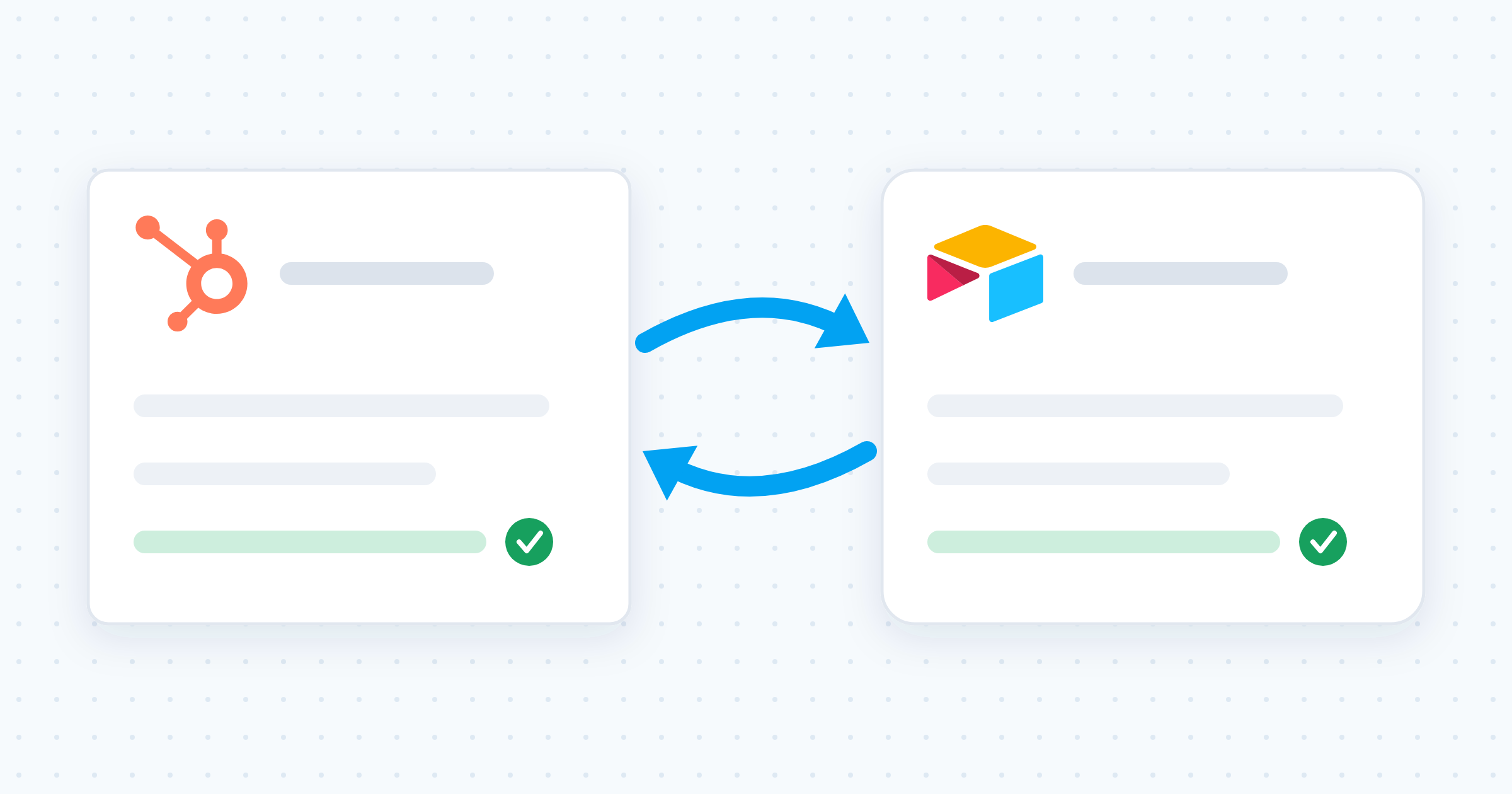
Every way to sync HubSpot and Airtable compared, with setup steps, the honest limit on each method, and how to run a real-time two-way sync.

How to sync HubSpot and Airtable (two-way)
Your CRM lives in HubSpot. Your operating tables live in Airtable. So someone exports contacts every week, pastes them into a base, fixes the columns, and by Friday the export is stale.
Quick answer: four methods connect HubSpot and Airtable. CSV export and import is free, manual, and out of date on arrival. HubSpot workflows push rows into Airtable one way and need a Professional or Enterprise plan. HubSpot’s native Airtable Data Sync app runs two ways but requires a paid Data Hub Starter subscription. A dedicated two-way sync tool like Whalesync keeps both apps matched in real time, with no-code setup in minutes. Choose by direction: if edits made in Airtable have to reach HubSpot, skip the first two.
Compare every way to sync HubSpot and Airtable
| Method | Direction | Effort | Best for |
|---|---|---|---|
| CSV export and import | Manual, one direction per run | Low once, repeats forever | A one-time migration |
| HubSpot workflow action | One way, HubSpot to Airtable | Medium, one build per trigger | Logging new records into a base |
| HubSpot Airtable Data Sync app | Two way, contacts and companies | Medium, paid tier required | Basic contact and company mirroring |
| Zapier or Make | One way per automation | High, one build per event | Branching logic and side effects |
| Whalesync two-way sync | Two way, real time | Low, minutes to set up | Editing CRM data from Airtable |
1. CSV export and import
The manual route. It is the right answer exactly once, for a migration.
- Export your HubSpot contacts to a CSV.
- Create or open an Airtable base and import the file.
- Repair the column types by hand. Dates, single selects, and linked records rarely survive.
- To push edits back, export the Airtable view and import the contacts into HubSpot.
Honest limit: the data is stale the moment you download it. Round-tripping edits invites duplicates and overwrites, and matching rows by email breaks as soon as either side edits an address.
2. HubSpot workflows (one way)
HubSpot ships a workflow action that writes into Airtable when something happens in the CRM.
- Connect Airtable to your HubSpot account.
- Go to Automation, then Workflows, and create or open a workflow.
- Add an action and choose Create Airtable row.
- Pick the base and table, then map HubSpot properties to Airtable fields.
Honest limit: HubSpot documents this action as creating rows, on Professional and Enterprise plans. Nothing flows back. Edits and deletions made in Airtable stay there, and existing records never move, because a workflow only fires on events after you switch it on.
3. HubSpot’s native Airtable Data Sync app
HubSpot publishes an Airtable Data Sync app in its own marketplace. This is the native two-way option.
- Install the Airtable Data Sync app from the HubSpot marketplace.
- Authorize your Airtable account, then pick the base and table.
- Choose the objects to sync and confirm the field mappings.
- Turn the sync on and let the first pass run.
Honest limit: the app is free to install, but HubSpot’s listing states it requires a paid Data Hub Starter subscription, and custom field mappings sit behind that same tier. Airtable’s support documentation describes the two-way path as covering contacts and companies. Reviewers on the listing, which averages 3.2 out of 5, report duplicate records and thin support for anything past basic text fields. It mirrors names and emails well and handles a field-level sync poorly.
4. Zapier or Make automations
Automation platforms watch for a trigger, such as a new HubSpot contact, then perform an action, such as creating an Airtable record.
- Pick the trigger app and event, then the action app and event.
- Map the fields for that one path.
- Repeat for every other event and direction you care about.
Honest limit: step three is the problem. New record, updated record, deleted record, in each direction, is six automations for a single table pair. Point two automations at each other and you risk an update loop. Bulk edits burn monthly task quotas fast, and your existing records still never sync, because triggers only see what changes after setup.
5. Dedicated two-way sync
A purpose-built sync tool treats HubSpot and Airtable as one dataset in two places. You map tables and fields once, and it keeps both sides matched in both directions, including records that already exist. Whalesync works this way, and so do Unito and Stacksync. Compare them on three things: whether historical records sync, whether individual fields can be set one-way or read-only, and setup time. Unito, for example, documents a five-step setup of roughly fifteen minutes and asks you to add a Last Modified Time field in Airtable first.
Why two-way sync beats one-way
One-way tools move data. Two-way sync keeps data agreeing, which is the actual job. For RevOps, that turns Airtable from a decaying snapshot into a live, editable window on the CRM.
- Edits flow both directions. Clean a column in Airtable and HubSpot updates. A rep changes a deal stage in HubSpot and the base reflects it in real time.
- Historical records sync too. Your existing HubSpot records land in Airtable when the sync activates, not just the changes made afterward.
- One mapping replaces many automations. No per-event workflows, no update loops, no task quota to watch.
How to sync HubSpot and Airtable with Whalesync
Setup is no-code. Have your Airtable base ready, new or existing, then follow five steps.
Step 1: Create a new sync. Sign in to Whalesync and create a sync, choosing HubSpot and Airtable as your two apps. A sync is the connection that keeps your tables matched.
Step 2: Authorize both apps. Connect your HubSpot account, then your Airtable account. Whalesync walks you through each screen and handles the API details.
Step 3: Map your tables. Choose which HubSpot objects, such as contacts, companies, or deals, pair with which Airtable tables.
Step 4: Map your fields and set the direction. Match the fields you want in sync. Individual fields can sync two-way, one-way, or stay read-only, so you decide exactly what Airtable may write back to the CRM. Leave Airtable formula fields read-only: Airtable calculates them, so nothing can write into them.
Step 5: Activate and watch it run. Turn the sync on. Whalesync syncs your existing records first, so both tools start from the same complete dataset. Then edit a cell in Airtable and check HubSpot: the change is there too.

What ops teams build once HubSpot and Airtable stay in sync
Bulk-clean the CRM from a spreadsheet view. Airtable gives you multi-cell selection, copy-paste, and grouping that HubSpot’s record pages do not. Sync your contacts into a base, fix job titles, standardize company names, and correct picklist values in bulk, then watch the fixes write back. Our guide to managing your HubSpot CRM from Airtable covers this workflow in detail.
Enrich ops tables with live CRM records. Campaign trackers, onboarding checklists, and account plans improve when the CRM rows inside them are live. Sync the contact list into this quarter’s planning base instead of pasting it: when a deal changes stage in HubSpot, the planning table already knows.
Retire the weekly import-export routine. If your team still runs a recurring HubSpot contact export or a monthly contact import, a two-way sync replaces both jobs with one connection.
Check three things before you turn any sync on
- Pick a source of truth per field, not per app. Lifecycle stage belongs to HubSpot. A project owner column belongs to Airtable. Write that list down before you map anything.
- Decide the matching key. Email is the usual choice and the usual failure, because people change addresses. A stable record ID matches more reliably.
- Respect Airtable’s API rate limit. Stacksync documents Airtable at five requests per second per base, so a mass update takes time to drain. Stage large backfills.
Frequently asked questions
Does HubSpot have a native Airtable integration?
Yes, two of them. HubSpot ships a Create Airtable row workflow action, which runs one way from HubSpot to Airtable, and an Airtable Data Sync app in its marketplace, which runs two ways. Airtable’s support documentation points at both. Neither gives you direction control on individual fields.
Is the HubSpot Airtable integration free?
The app is free to install, but HubSpot’s listing states that activating the sync requires a paid Data Hub Starter subscription, and custom field mappings need that same tier. The workflow action requires Professional or Enterprise. On a free HubSpot account, CSV or a third-party sync tool are your options.
Can Airtable write back to HubSpot, or is it read-only?
It depends on the method. Workflows, Zapier triggers, and one-way feeds are read-only from Airtable’s side, so your edits stay put. A two-way sync writes back, and a good one lets you choose per field: Airtable can update a job title while deal amount stays read-only.
Can I sync HubSpot deals to Airtable, not just contacts?
Airtable’s documentation describes the native two-way path as covering contacts and companies, and marketplace reviewers have asked for deal support. Whalesync maps HubSpot objects such as contacts, companies, and deals to Airtable tables, so a deal pipeline can sit next to your project tables.
Why is my HubSpot Airtable sync not updating?
Start with three causes. The record predates a trigger-based automation, so it was never in scope. The field is computed in Airtable, such as a formula or a rollup, so nothing can write into it. Or the mapping broke when someone renamed a field. Check the mapping first.
Ready to stop copy-pasting CRM data? Start a free Whalesync trial and set up your HubSpot and Airtable sync in minutes.
Subscribe for more
Stay up to date with the latest no-code data news, strategies, and insights sent straight to your inbox!